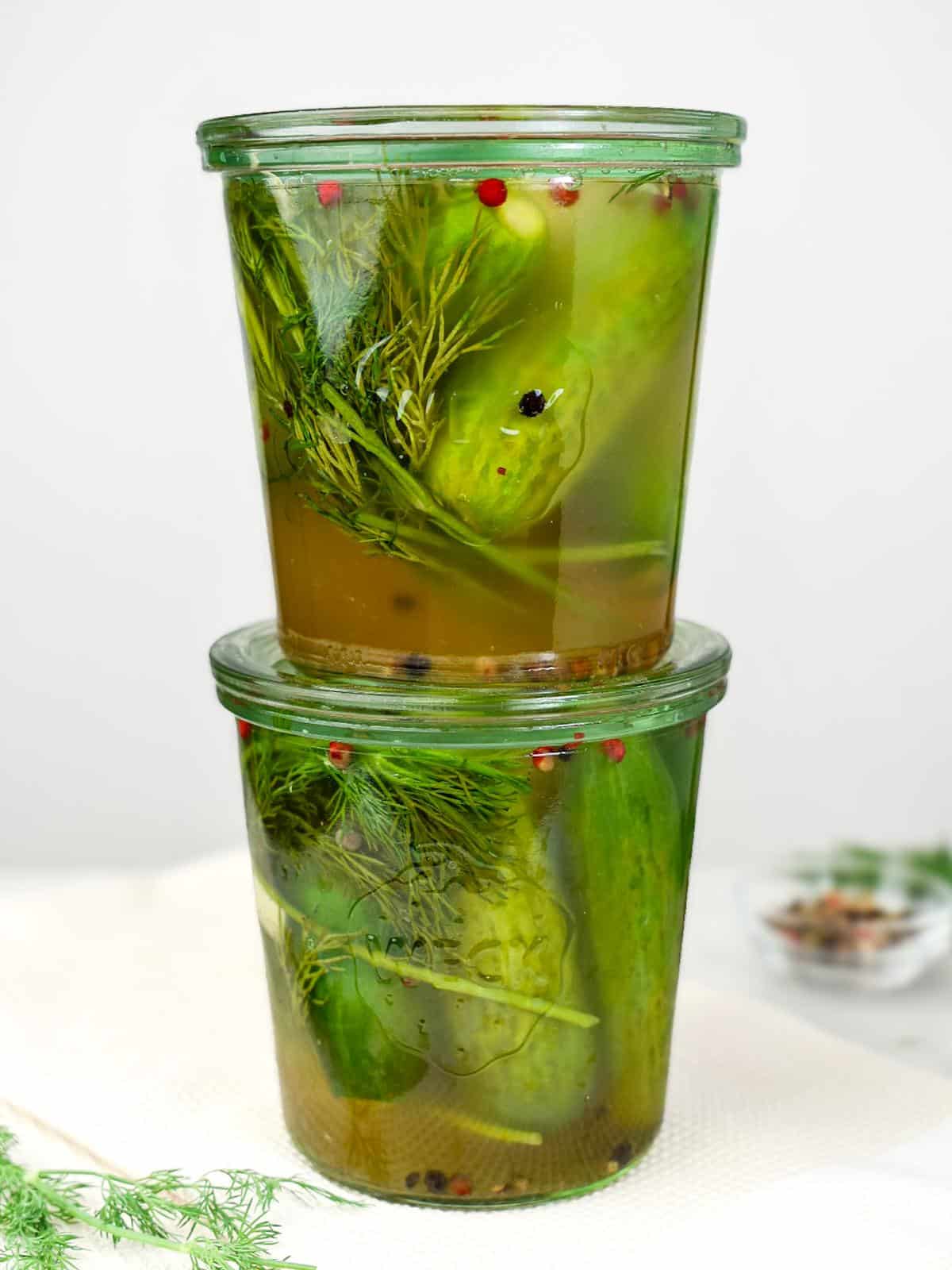
Servings : pickles
Save this recipe
Love this recipe? Get it sent to your inbox.
Equipment
Ingredients
Instructions
- Trim the blossom end off 10 to 14 small persian cucumbers. Find the rounded end (opposite the stem scar) and slice off about ⅛ of an inch. This is where the enzymes that cause mushy pickles are so don't skip this.
- Soak the cucumbers in ice water for 30 minutes while you prep everything else. Cold cucumbers make crunchier pickles, and this is one of the most underrated steps in the whole process.
- Stir 21 g fine sea salt or pickling salt into 2½ cups filtered or non-chlorinated water until fully dissolved. If you used warm water to speed it up, let the brine cool to room temperature before using (or use 1 cup warm water to dissolve the salt, then add 1½ cups cold water..)
- Divide 6 cloves garlic and 2 tsp whole black peppercorns. Pack the cucumbers in tight and upright. Add 1 bunch dill, split between the jars in over the top of the cucumbers. Add ¼ tsp pickle crisp between the two jars if using.
- Pour the brine over the cucumbers until fully submerged, leaving about 2cm of headspace at the top.
- Drop in a fermentation weight or a smaller clean jar to keep everything under the brine. Anything floating above the liquid can grow mold.If you don't have anything you can use as a weight, you can also fill the jars all the way to the top with the goal of having no air bubbles when you put the lid on. It works in a pinch but isn't the ideal method.
- Seal loosely. With Weck jars, rest the glass lid on top and skip the metal clips so gas can escape. For mason jars, screw the lid on loosely or use a fermentation airlock.
- Set the jars on the counter out of direct sunlight, ideally between 65 and 72°F (18 to 22°C). Put a plate and a paper towel underneath. The brine will bubble and might overflow in the first couple of days (that's a good thing!)
- Start tasting on day 3. Pull one out and bite into it. If it's tangy, still bright green, and has that audible snap, you've hit half-sour territory. Move the jars to the fridge. If you want more punch, leave them another day or two.
- Once refrigerated, they'll keep for 2 to 3 months and will continue to deepen in flavor over time.
Nutrition
Notes
- Cucumbers: Persian cucumbers are ideal because they're small, thin-skinned, and low in water content. If you can find true pickling cucumbers like Kirbys, those are the gold standard. Skip regular slicing cucumbers. Their waxy skins and high water content will give you mushy pickles.
- Salt: Use fine sea salt, pickling salt, or kosher salt. Skip iodized table salt. The iodine inhibits the lactobacillus bacteria you need for fermentation and will cloud the brine.
- Water: Chlorinated tap water will also kill your ferment. Use filtered, bottled, or tap water that's been left uncovered overnight to let the chlorine dissipate.
- Cloudy brine is good. A cloudy, bubbly brine means fermentation is working. The white sediment at the bottom is lactobacillus doing its job.
- What you don't want to see: Fuzzy mold, pink or orange slime, or anything that smells rotten. If any of that shows up, toss the batch and start over.
- Timing varies by kitchen temp. A warm kitchen might hit half-sour in 2 to 3 days. A cooler kitchen can take 5 to 7. Trust your taste buds more than the clock.
- Jars: Weck jars vent gas naturally when you leave the clips off, which makes them a nice choice for fermenting. Mason jars work fine too. Just leave the lid loose or burp them once a day by unscrewing briefly to release pressure.